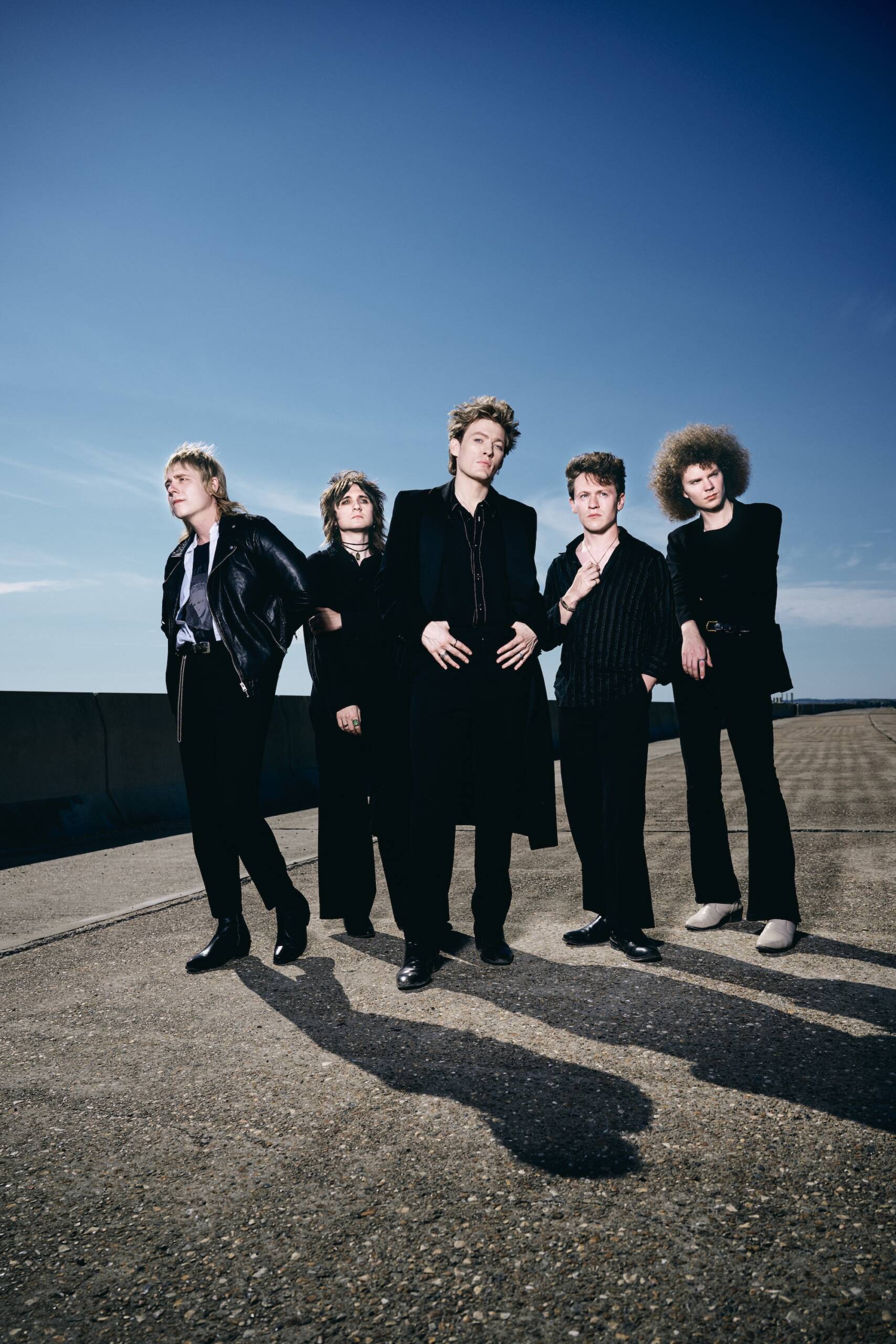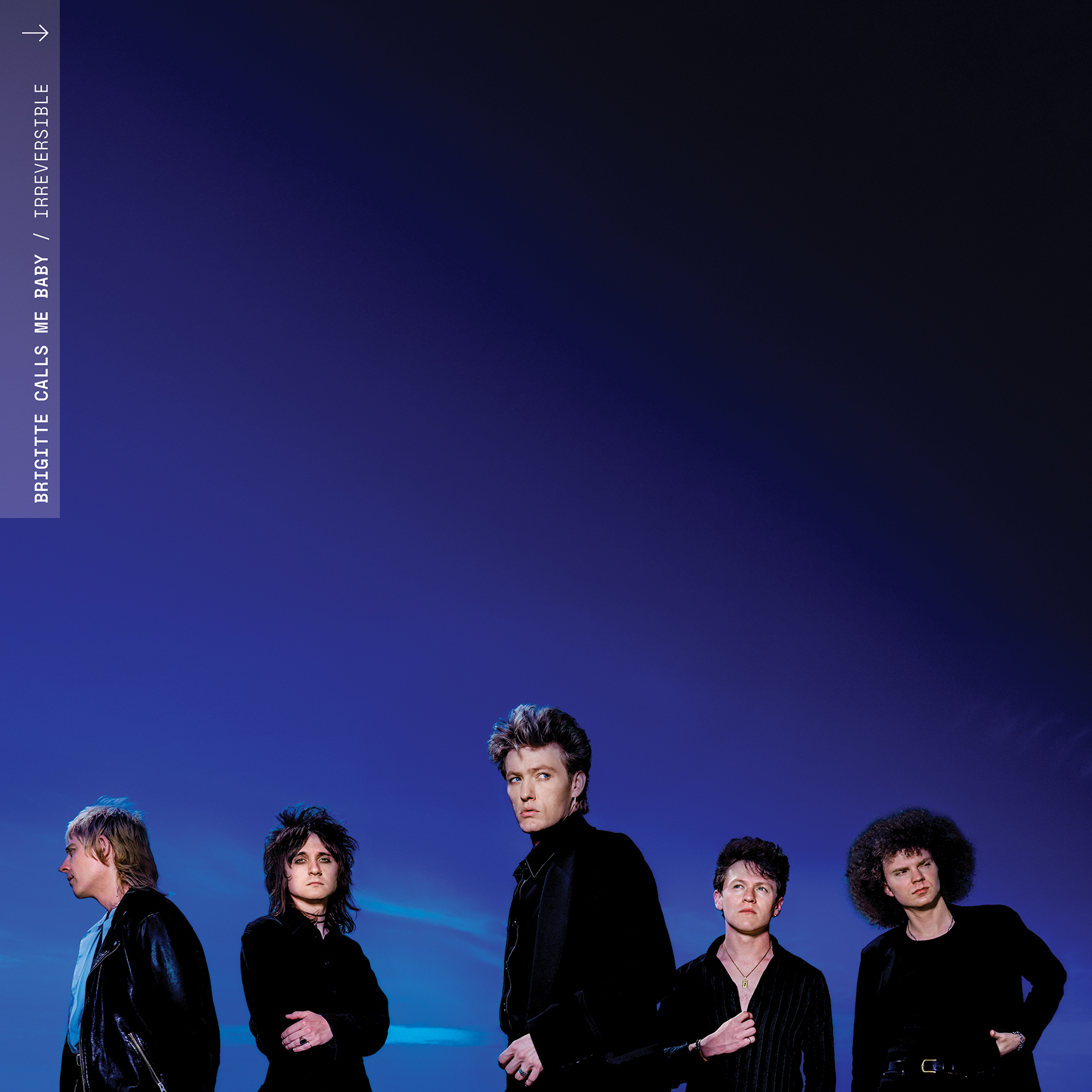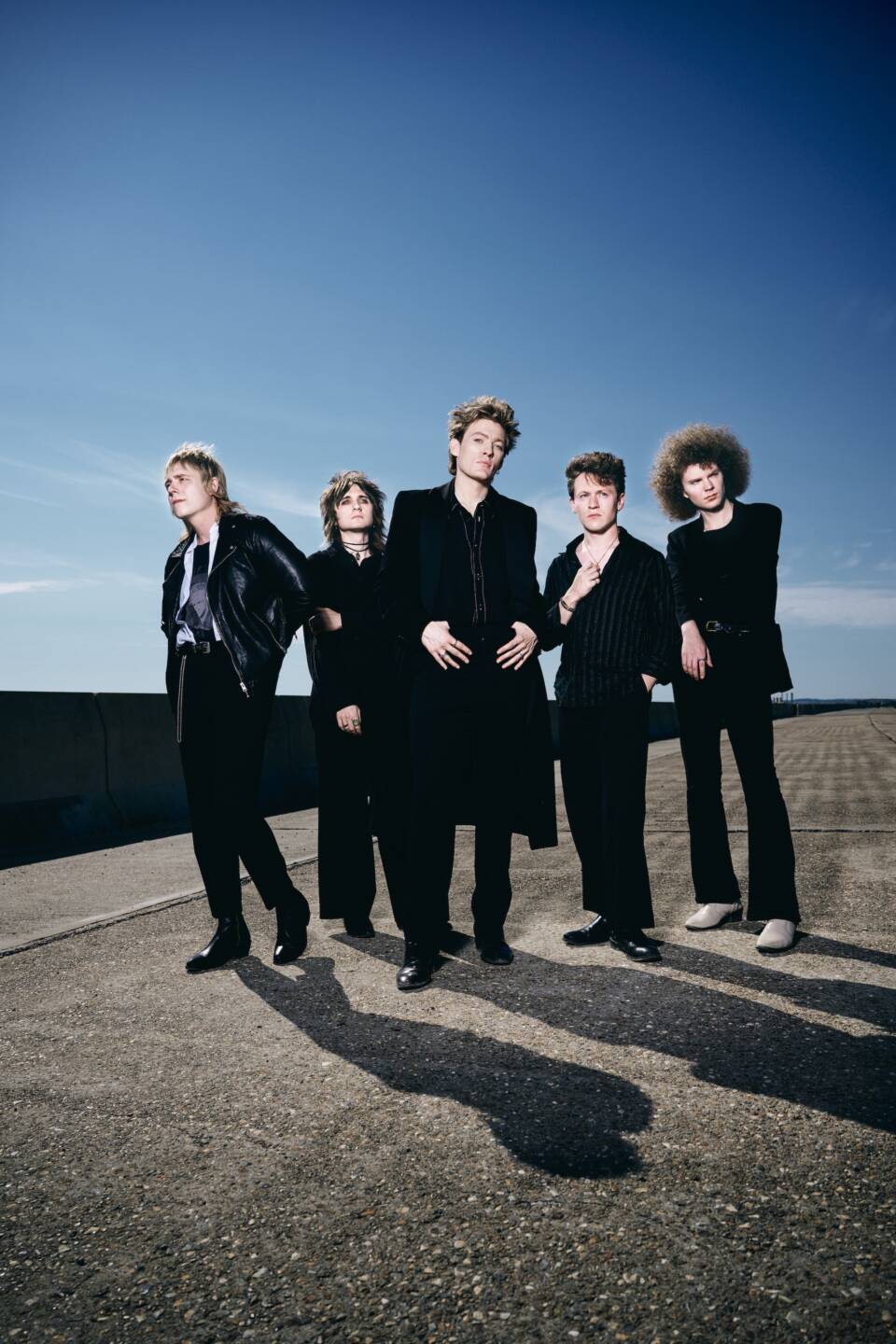
In the larger-than-life world of Brigitte Calls Me Baby, our most difficult emotions become beautifully warped into something sublime: heartbreak turns to melancholy, desperation takes on a poetic glamour, infatuation becomes something unruly and impossible to contain. With their lavish and electrifying breed of alt-rock, the Chicago-based band doesn’t seek to resolve these feelings so much as sit inside them: idealizing, interrogating, and ultimately surrendering to their emotional weight. It’s a sensibility that’s earned the band a diehard following since forming in 2022. In a major leap forward for Leavins and his bandmates—guitarist Jack Fluegel, bassist Devin Wessels, drummer Jeremy Benshish—Brigitte Calls Me Baby’s sophomore album Irreversible pushes further into the exquisite pathos of their songwriting, all while fully capturing the transcendent grandeur of their live show. The result: a majestic suite of songs that burn bright, hit hard, and passionately celebrate the drama of being alive.
Produced by Yves Rothman and Lawrence Rothman (Los Angeles-based brothers whose collective credits include Blondshell and Yves Tumor), Irreversible marks the follow-up to Brigitte Calls Me Baby’s widely lauded debut album The Future Is Our Way Out—a 2024 release that delivered standouts like “Impressively Average” (a Top 10 hit Triple A radio) and earned praise from tastemakers like Jimmy Kimmel Live!, SPIN and NME (who noted that “[i]n having so much fun with their legendary touchstones, Brigitte Calls Me Baby have carved out a triumph of their own”). Over the past few years, the band has toured relentlessly through the U.S., U.K., and Europe, moving from small rooms to sold-out headlining shows with a sense of disbelief that slowly gave way to confidence. Touring alongside bands like Fontaines D.C and Morrissey. only reinforced their instincts, offering irrefutable proof that there’s room for music that refuses to flatten its edges.
Much of Irreversible was written in transit: lyrics scribbled in hotels and Airbnbs, melodies rigorously analyzed over headphones, voice memos traded back and forth between Leavins and Wessels while the rest of the world slept. When Brigitte Calls Me Baby returned to Chicago for brief stretches, they’d flesh out those songs before heading back out on the road, then further refine them in soundchecks and test the new material live. In San Diego, when a song called “Slumber Party” was added to the set on a whim, the crowd’s feverish reaction made something click—the band realized they weren’t just gathering ideas; they were building a record. “It’s been mind-blowing to see the way people are responding at our shows lately,” notes Leavins, who’s now encountered a number of fans with his likeness tattooed on their bodies. “The experience of being onstage and watching people sing along and even cry to our songs has really affected us, partly because it’s evidence that the vulnerability of our music is being completely embraced.”
That exacting but illuminating process left the songs exceptionally dialed-in by the time Brigitte Calls Me Baby entered the studio with the Rothmans, whose work with artists like Girl in Red and Angel Olsen proved immensely inspiring to the band. Recording sessions were intentionally brief—four-hour days that prioritized intuition over excess—because the songs already knew what they wanted to be. In a profound evolution of their debut, Irreversible is more layered and less direct, allowing for more texture, tension, and space to linger in emotional extremes. “Our first album taught me that you’ve got to reach as far down into your soul as possible and be willing to show something real and raw to the world, and with this album that felt even easier and more natural,” says Leavins. “There was a time when I tried to bury the kind of feelings we’re displaying on this record, but now I’m at the point where I don’t feel the need to hold anything back.”
Thematically, Irreversible centers on acceptance: of reality, of time, of the present moment as something that can’t be undone. Death and its inevitability loom large throughout the album—not as shock value, but as a quiet motivator. While touring, Leavins has made a ritual of visiting graveyards as a form of exposure therapy, stopping in places like England’s Abney Park Cemetery to sit with the fear rather than avoid it. That confrontation with impermanence runs through Irreversible, which views death as the ultimate transition. Many of the album’s love songs wrestle with desire in its most unwieldy form: the wish to fully possess another person, or be possessed in return, even while knowing that kind of unity is impossible.
A driving force for Irreversible’s emotional arc—“Slumber Party” delves into the darkest corners of the human psyche. “I wrote that song thinking about the type of people who isolate and ruminate, to the point where it becomes a chore to leave the home,” says Leavins. A supreme introduction to Irreversible, “There, Always” kicks off the LP with a moody and luminous reflection on the wildly unreliable nature of love. Later, on “I Danced With Another Love In My Dream,” Brigitte Calls Me Baby present a paradoxically euphoric portrait of hidden desire. “That song started with us attempting to write something happy, but somehow found its way to being about infidelity,” says Leavins. “We played a few different versions live and in the end decided to lean into the bright and shiny side of it, and it turned into a song where those adulterous thoughts are carried out in a dream scenario.”
An instant transmission of pure unfiltered feeling, Irreversible explores everything from existential anxiety (on “Truth Is Stranger Than Fiction”) to generational cycles of depression (“The Pit”) to the toxic self-delusion of the emotionally manipulative (“I Can Take the Sun Out of the Sky”). Meanwhile, on “These Acts Of Which We’re Designed,” Brigitte Calls Me Baby share an incandescent piece of synth-pop built on pulsating beats and a chilling narrative of repressed obsession. For the final cut on Irreversible, Brigitte Calls Me Baby dreamed up a track called “Send Those Memories”: a gorgeously heavy-hearted number that wholly encapsulates the fatalism of the album’s title. “‘Send Those Memories’ is about romanticizing the past, as I do often, but it’s also about coming to terms with the fact that there’s no going back and you’ve got to find a way to create something good in the present moment,” says Leavins.
Centered on a boldly singular sound that feels both thrillingly new and immediately essential to the modern rock landscape, Irreversible spotlights the distinct narrative voice Leavins first cultivated by writing songs as a 13-year-old kid in Port Arthur, Texas. “My whole inclination toward music came from being in this small town in Texas with nowhere to go and nothing to do, and wanting to be understood without having to say anything,” he says.
Despite its fascination with the more shadowy dimensions of our emotional lives, Irreversible bears a subtle undercurrent of hope—a sense that peace can arrive when you stop resisting what is. And with the release of Irreversible, Brigitte Calls Me Baby aim to impart others with a similar sense of hopeful determination. “All these songs just come from writing about what genuinely touches me, whether it’s my own experience or something I’ve observed in others,” Leavins acknowledges. “But in the end I want them to give hope to people who are yearning for something—whether that be in the romantic sense, or in the sense of finding a place in the world that truly feels like theirs. I want to leave people with the same sense of possibility I’ve always found in the music I love.”
Publicity Contacts
Press Kit
Photos