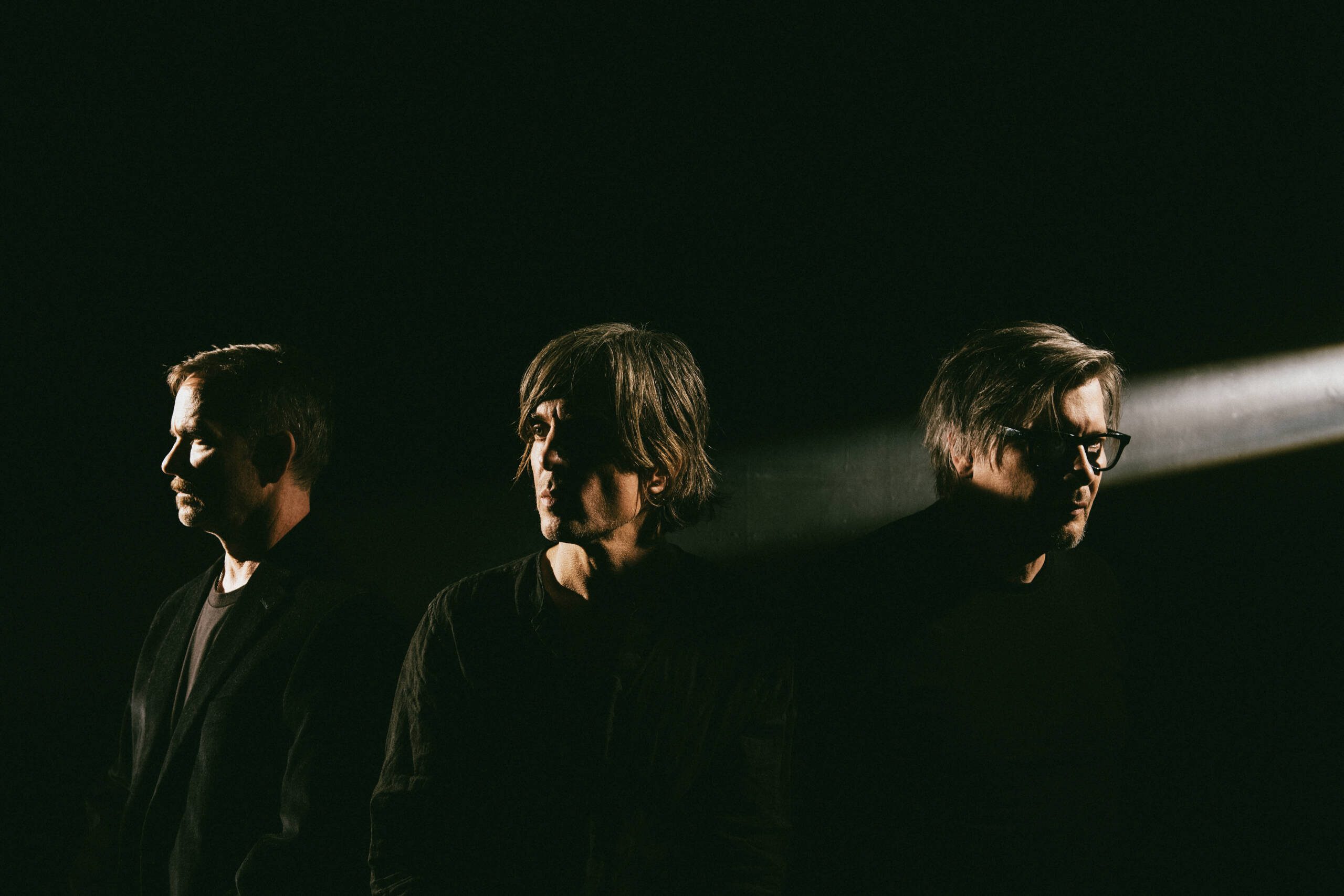
For a band so closely associated with weight, density, and mass, Failure have spent much of their career writing about what happens when those things fall away. Bodies drift. Memories fragment. Signals distort. Gravity fails. But even after 30 years, the hugely influential trio of Ken Andrews, Greg Edwards, and Kelli Scott are still following the sound wherever it leads, even when it’s uncomfortable, unfamiliar, or disruptive.
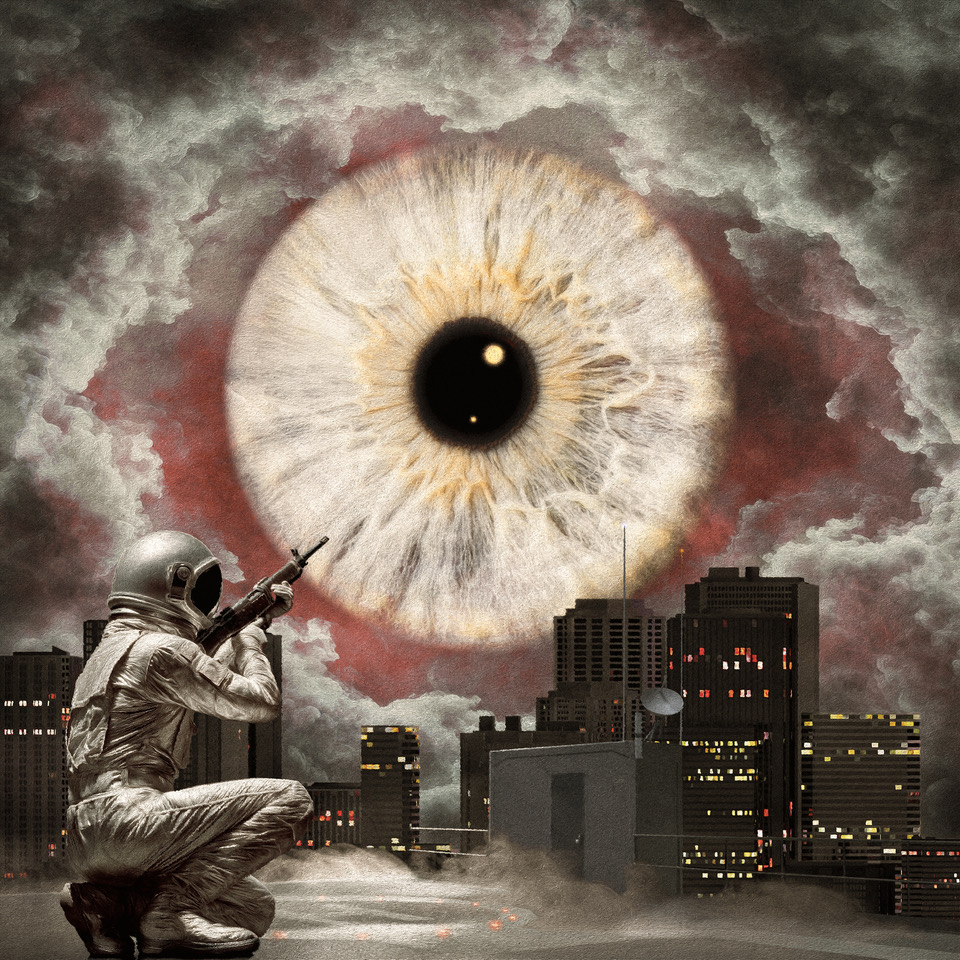
Location Lost, the band’s seventh album and their fourth since improbably reuniting in 2014 after a 17-year-hiatus, doesn’t arrive as a victory lap or a nostalgia exercise. Instead, it sounds like a band actively negotiating where — and who — they are now. “It’s very different,” Edwards says plainly of the nine-song follow-up to 2021’s Wild Type Droid. “There are sounds and parts that really don’t have any precedence within the Failure world.”
That sense of divergence is inseparable from how Location Lost came together. Following Wild Type Droid, Failure completed a long-gestating documentary (Every Time You Lose Your Mind) and concert film (We Are Hallucinations) that chronicled their history, drug-marred breakup, and improbable second life playing for a newfound younger and more diverse audience. The process was exhaustive, and revealing.
Almost immediately after finishing the film, Andrews suffered a serious back injury that required surgery. The operation was technically successful; the recovery was not. “It kind of messed up my brain chemistry somehow,” he says. “It wasn’t just physical recovery.” By late 2024, Failure were finally able to begin recording in earnest. As with Wild Type Droid, Andrews, Edwards, and Scott rented a studio and spent weeks improvising together as a trio, recording hours of unfiltered material without overthinking where it might lead. But the dynamic inside those sessions had shifted.
Andrews, still recovering, felt creatively unmoored. “I was participating, but my editorial side just wasn’t working,” he says. “Luckily, Kelli and Greg were able to step up and take the lead in terms of confidently saying, ‘that was a good idea.’ We had a lot of material, but I didn’t know what it was.” Edwards noticed it too. “Ken was there in actual physical bodily presence,” he says, “but I don’t feel like he was really able to get lost in the music or become part of the flow of that creative part of the record. Even if you’re the most well-adjusted person in the world, surgery has an emotional dimension. It can be destabilizing.”
When Andrews took the sessions back to his L.A. home studio and began shaping them into songs, something unexpected happened. “I had a burst of creativity—especially lyrically. Since we rebooted, Greg’s been the more dominant lyrical force. That completely flipped on this record,” but not before Edwards suggested the song “Location Lost” also serve as the album’s title. “It resonated with me immediately, because at the beginning of making the record, I was lost,” Andrews says. “I lost my tether of love for the band. By the time we finished it, I felt totally reconnected.”
Musically, that reconnection manifests as the most varied record Failure has ever made. There are simpler, more driving songs than the band has historically favored, two ballads (an anomaly in their catalog) and moments that feel almost willfully alien. “I was just following what felt good,” Andrews says. “More of the editorial side of my brain was turned off. It was not calculated, but there’s something about it that’s a little more accessible..”
Throughout, Location Lost delivers dose after dose of Andrews, Edwards and Scott’s utterly unique creative and instrumental interplay, from the warning bell-like guitar chimes on propulsive opener “Crash Test Delayed,” to the elastic, bass-driven groove of “Halo and Grain” and the grinding, methodical wall of sound on “Solid State,” which wouldn’t have sounded out of place on 1996’s all-time-classic Fantastic Planet.
Other songs such as the slow-burning, dream-inspired closer “Moonlight Understands” and the stuttering “Someday Soon” emerged from singular, unrepeatable moments. “As soon as I heard Kelli’s beat and the sound Greg was making with an E-bow, I was like, ‘we have to make a song around that,’” Andrews says of the latter, the oblong rhythms of which almost resemble Synchronicity-era The Police. “There’s nothing in our catalog like that.”
“The Air’s on Fire” is the album’s most literal confrontation with Andrews’ medical trauma, its oppressive atmospherics and crushing bottom end mirroring his struggle to breathe on his own. “That song is directly about my surgery and waking up,” he explains. “I basically coded. Everything was spinning. I kept saying, ‘Turn the air on. I’m fine—just take me home.’ I was definitely not fine.”
At the opposite emotional pole is the largely acoustic, straight-up breakup song “The Rising Skyline” featuring Paramore frontwoman Hayley Williams, an artist whose longtime public admiration for Failure has unquestionably helped introduce the band to an entirely new generation of listeners—a good deal of them female. Williams also appears in the 2023 documentary, underscoring her long-standing connection to the band.
“I heard a female voice an octave higher when I was writing it,” says Andrews of the collaboration, which was hatched while he and Williams rehearsed an acoustic version of Failure’s “Daylight” for an early 2025 benefit for Los Angeles wildfire victims. “We ended up having a day together, so I dropped a couple songs on her and she freaked out.”
“That song made sense for her emotionally,” Edwards opines. “It’s acoustic and very sad, but also wistfully hopeful. I always love music that’s so sad it makes you feel good. Quite a bit of our stuff has that strange counterintuitive quality to it, and it was nice to have her sing on one of those moods.
Three decades after Fantastic Planet, Failure is not attempting to relive the past. They’re still improvising, still arguing, still trusting one another enough to risk uncertainty. And while Location Lost doesn’t pretend to offer easy answers, it documents a band in motion, untethered and searching — and, against all odds, still very much alive.“This is the least cohesive record we’ve ever done,” Edwards says. “Emotionally, thematically, procedurally. But I don’t think that’s a negative. I think that may be one of its strengths.” He continues, “Fantastic Planet and [2015’s] The Heart Is a Monster were separated by a long, yawning inflection point. Afterward, it felt like a moral imperative to see this thing through a second phase. Is Location Lost the last Failure record, or could it be the transition to yet another new phase? We’ll see where it goes from here.”
Publicity Contacts
Website
Press Kit
Photos