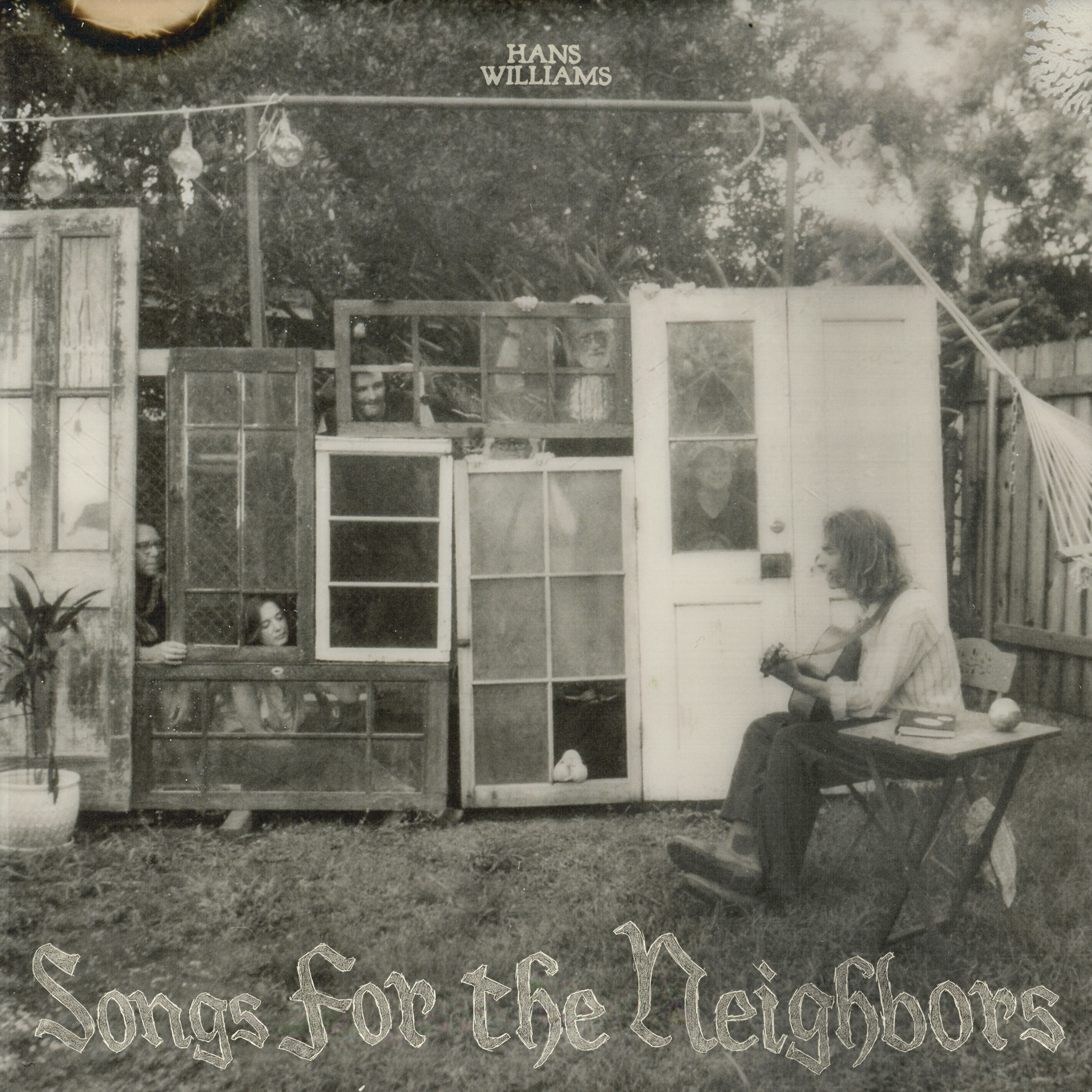
How well do you know the people who live beside you down the street, or over the fence? Hans Williams’ debut long-player, Songs for the Neighbors, was born in his backyard in situations not so unlike the Polaroid that graces the album cover: Williams, often with some friends, making music in their little patch of paradise in New Orleans’ Bayou St. John area while the neighbors listen through their doors or windows or from the next garden over. The album trades in soulful, dreamy folk that borrows here and there from funk, psychedelia, and country — all tied together by the sweetness, melancholy, and joy that run freely through Williams’ nimble voice. Songs for the Neighbors is aptly intimate while reaching toward connection, built by being together.
“With the backyard shows, we wanted to bridge that gap of disconnect in the world that feels so insurmountable,” Williams says. He’s referencing not just his penchant for jamming audibly, but also a series of small gigs he and his roommates put on the last couple years. His live band comprises the same local fellas who play with him outside and on the LP: Elliott Miller (bass), Isaac Worley (drums), Richard Rourke (keys), Jonny Campos (pedal steel), and Joe Pizzolato (guitar). Meanwhile, Williams’ old pal, housemate, and longtime collaborator Phin Choukas (Noah Kahan) produced Songs for the Neighbors, which they recorded right there at the house. “It feels so difficult nowadays just to have something close and connected and tight,” Williams adds, “and I’m really lucky to have found that with a lot of my neighbors, some of them in their 70s and still up at 11 p.m. Everyone’s just so happy to hear a voice in the neighborhood.”
That world comes to life with the opening lines of the first track “True Feeling,” as Williams finds inspiration in the independent spirits and easy love of his neighbor Jake’s cat and his old roommate Tom’s dog. As the adventures of Maggie and Darcy unfold — meandering but with momentum — Williams sings about approaching a similar mindset: “Walking in my steps again, shouting out like a free man / He is broken and unworthy of her smile, and loving everybody for a little while / It is all I need and all I want, something that don’t belong / It’s true feeling.”
Within that poetry teetering on the edge of happy madness is the idea that being utterly open in your relationships with people ignites a type of freedom, both personal and artistic. That concept is essential to Songs for the Neighbors. See, for example, the Marvin Gaye-evoking soul of “Harding Road” which pays tribute to his relationship with his partner Olivia. Even Williams’ attitude toward something as personal as lyric-writing works on the assumption of contingency, a belief that we make the most meaningful meaning together. While his words sometimes come out like a cloud of loosely bound verse, they’re hardly diaristic — they feel outward-reaching.
“Having someone there gives the words meaning and maybe gives me a chance to more deeply care about what I’m saying, to almost self-edit in a way,” Williams says. “If someone is there — or I can convince myself another entity is there — the words come out with more weight.”
His choice of the word “entity” is no accident. There is a specific presence — in the way that absence creates presence — that is often there with Williams, moving through a swath of Songs for the Neighbors. When he was just a couple days into college, Williams wound up as the first responder to a kid named Jake who died by suicide. “It’s something I carry with me,” he says. “It changed my life so fundamentally that I can’t really go a day without him being here by my side.”
“Holey Fence,” with its plaintive, woozy arrangement, and the floating “Never Too Quiet” are both songs for Jake, attempts to muster up some faith that he’s found some relief and maybe also a subconscious effort not to forget the harsh reality of what happened. “Like many people in my life, I feel reminded of him often, even though he’s not there — in the flicker of light in the trees, for example — and songs are just another way people remain present,” Williams says.
Perhaps the main specter haunting Songs for the Neighbors is the desire to reach across a void and touch, hear, see somebody. Lyrically, there are barriers — physical and otherwise — that Williams yearns to drift through like a ghost. “I dance to a silent song, sing through the wall,” he coos on the delicate “Where It Goes.” “And wait for you to find I get down on love sometimes.”
If he does sour on communion, it’s only for a moment. It seems like nothing would persuade Williams that it wasn’t worth it to keep reaching. Over the buoyant rise of “The Door,” helped along by Oly Tuttle’s trombone, he pledges that he’ll be there at the threshold for the receiver of his song, despite the constant flux of the world. On the gossamer “Easy Eyed,” he contrasts his open-hearted naivete against the heavy load of another’s secrets. And across the smoky funk simmer of “In the Dark,” Williams employs his expressive tenor — like a duskier Jeff Buckley — to impel listeners to fight against the forces that try to build barricades between us: “Wherever you are, be the light that you are / Wherever you go, don’t you stand in the dark.”
The lived-in feel, the laidback groove, and the closeness of Songs for the Neighbors comes largely in thanks to Williams and company recording live at home — something he hadn’t done before. In hindsight, it’s maybe the only way this body of work could have ever come together, in the same spirit as the informal get-togethers where so many of these songs first took shape.
“I think there’s something really sacred about a bunch of people playing music simultaneously and having those frequencies happening all at once instead of trying to completely choreograph the whole thing,” he says. Indeed, the slow, earthy unfolding of the album closer “Marie’s Moon” creates a feeling of dropping into a dream world, one where even the empty air seems weighted with meaning. Marie is Williams’ grandmother, who has persevered in the face of devastation to continue moving willfully toward her faith. “Are you watching the moon again?”, Williams sings kindly before asking, “Can you let it go?” as if casting a spell to release us all from our burdens.
It’s the album’s final uplift, another song that finds purchase and purpose in reaching out, “for someone I know, someone I wish was here,” Williams says, “someone I hope is listening.”
Publicity Contacts
Website
Photos