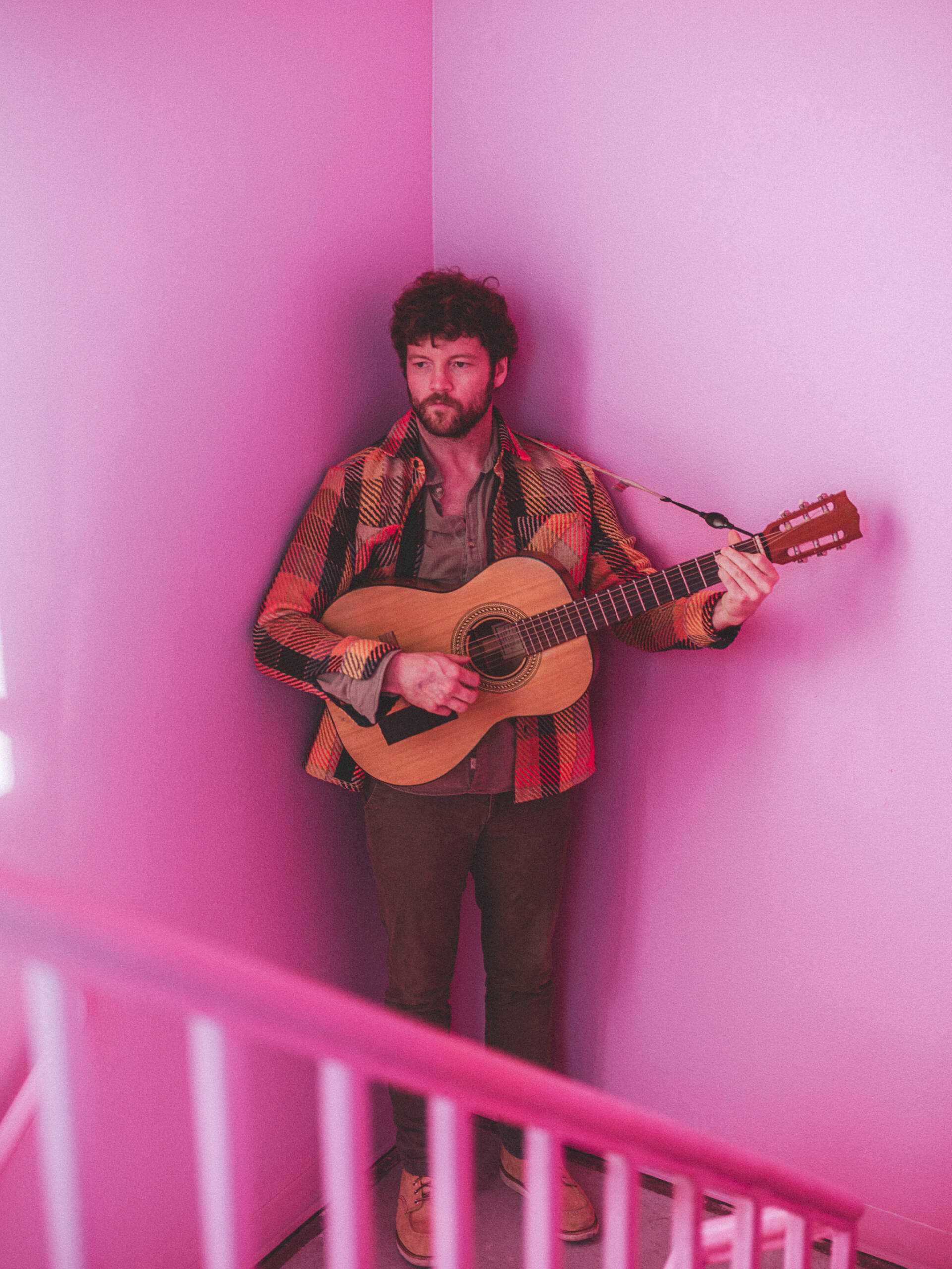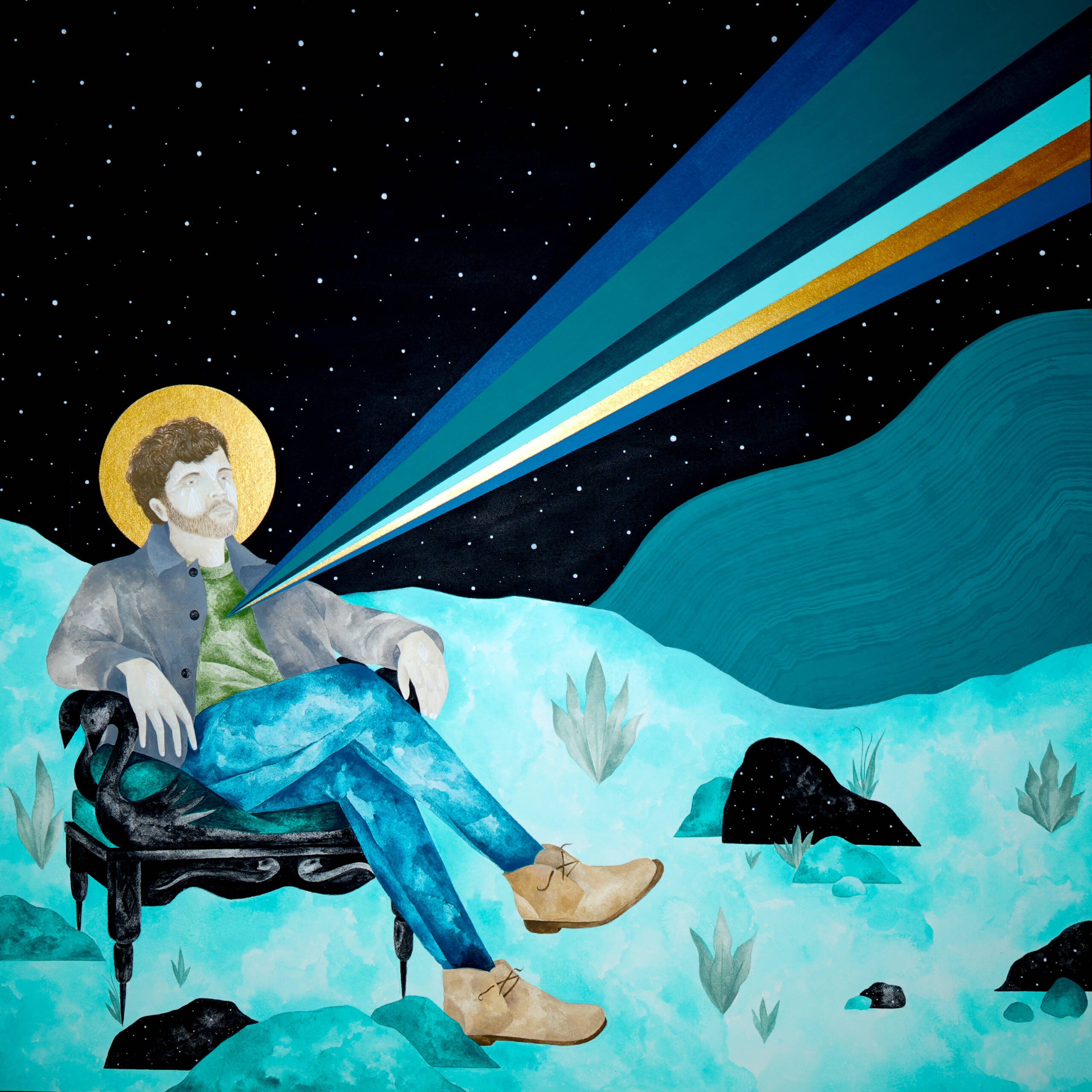
Several years ago, Keenan O’Meara had settled into a steady groove working in construction as a day job and doing music for fun in his downtime. However, he soon had his life and career turned upside down after striking up a friendship with Zach Bryan. In 2025, the country star tapped O’Meara to open several shows, including one that Bryan played with Bruce Springsteen and another in front of a record-setting 112,000 people at Michigan Stadium, raising the Catskills-based musician’s profile considerably.
O’Meara’s debut album, the largely acoustic Bathe in the Everlasting Light, reflects a knack for subtlety. Recorded in a studio he built in his home, the music is hushed and intimate. Each guitar strum or piano chord sounds crisp and distinct, while the occasional string or woodwind accent adds homespun feel. O’Meara’s voice is a keening croon that’s delicate and lightly weathered, giving the music emotional heft.
The songs on Bathe in the Everlasting Light emerged after O’Meara began writing music with friends. During an intense three-week span, everyone in the group would write a song a day, upload the tune to a shared online folder, and then provide feedback on each other’s work. “It’s a way to create accountability, produce music every day and work up your songwriting muscle,” O’Meara explains. “And it’s a wonderful experience creating a routine with your output and your creativity. I would get off the job site, come home and I’d try and write a song in an hour.”
In addition to O’Meara and his partner Meg Lui (an artist in her own right signed to Asthmatic Kitty) the group included Hannah Cohen, Sufjan Stevens, and Sam Evian. “The prospect of having all these great writers on there was really intimidating,” he admits. “It made me confront songwriting in a way that I hadn’t before.” In practice, that meant putting his inner critic aside and worrying less about finding the perfect moment to write a song. Instead, O’Meara followed his instincts and wrote quickly; as a result, all but three songs on Bathe in the Everlasting Light emerged from this exercise. “I used to have so much neuroticism about writing,” he says. “But this taught me that you just have to carve out time and pull songs out of the ether. Then you’ll have music you really like and want to work with.”
As it turns out, however, the songwriting group was a stunningly creative period for each participant, where the mutual inspiration and support pushed the musicians to new artistic heights. Much of Lui’s forthcoming full-length came out of this group, as did the songs on critically acclaimed albums such as Stevens’ Javelin and Cohen’s Earthstar Mountain. “It was a wonderful experience with some of my favorite writers,” O’Meara says. “There was an urgency and intensity to that whole experience that helped me find out where the rubber met the road with my songwriting ability.”
Given Bathe in the Everlasting Light’s origins, the album possesses a cohesive thematic feel that captures a pivotal moment in O’Meara’s life. “At that time, I felt like I was between big things, and it was a great time to play with the different colors and palettes that were out there in the world,” he says. “Almost all of the record is about death in some way, save for a few songs here and there. But it was quarreling with different ideas on how to think about death and how to think about what it means to be living and what it means to be at this juncture in my life.”
Inspired in part by being in Stevens’ creative orbit, O’Meara gravitated toward lyrics that strive to illuminate universal truths from deeply personal experiences. “Sufjan’s music has a lot of really expressive and intimate insights to his inner life,” he says. “But there’s a lot of observational stuff. There’s a lot of taking the outside world and repackaging it in different ways to people. And so that’s what my record was. It’s the first time I’ve ever done that.”
The single “Halley’s Comet,” for example, is a “meditation on the end of the world” in which the narrator finds himself drowning in regrets when the apocalypse hits: “I’ll get hung up on the past/I’ll beat myself up.” Honeyed guitar and shirred woodwinds propel “Devil Never Said Her Name,” a beatific folk song honoring the tenacity and benevolent spirit of O’Meara’s “sharp as a tack” 97-year-old grandmother. On the beautiful standout “Mourning Doves,” which is narrated by his niece Ada Florence Keenoy, warbling woodwinds describe the intensity of love, loss and grief, as captured by the cooing birds.
On other songs, O’Meara weaves mythological references into the lyrics, creating entire immersive universes that ruminate on humanity and the afterlife. Majestic strings from violinist Hannah Lynn Cohen and cellist Ana Lei dominate “God’s Last Hunter” whose fictional protagonist is a creature who awakens from a thousand-year nap to kill. The hunter leaves the encounter satiated, but grapples with feeling selfish (“I deserve your kin/I deserve to eat”) and guilty (“I feel much better/and I feel so bad”) because of his actions.
The title track is another “mythological fabrication of sorts” about someone who doesn’t realize he’s died. While stuck in limbo, he finds solace in the “eternal glow of a Wawa sign on Evergreen and Sunrise Road,” a striking image that conjures the liminal haze between life and death. Fittingly, the lyrics also reference Charon, a figure who chauffeurs souls across the river in the Greek mythology’s underworld, “playing dice with his own teeth” on the tailgate of his truck.
“The song’s main character is dealing with the surreality of not quite being here, but also not quite being where he’s supposed to be next,” O’Meara says. “There’s a lot of tedium about the suburbs that’s well-documented in art and American mythology. But to me, it was a fun idea to marry the banality of the suburban aesthetic with these huge, timeless concepts.”
In the end, Bathe in the Everlasting Light ended up being a “weirdly prophetic record,” O’Meara notes. In the period after these songs were written and the record was done, his mother died; his father developed cancer; and he welcomed his first child. And while recording Bathe in the Everlasting Light, his life changed in another big way: O’Meara received a message from Zach Bryan, who reached out via social media and asked if he could press some of O’Meara’s old records on his label.
Having recently started a throwback vintage country band, O’Meara was completely unaware of contemporary trends or Bryan’s burgeoning popularity. “I was listening to the Fleetwoods and Eddy Arnold at work while swinging a hammer,” he recalls. “I was so under a rock. And so when Zach reached out, it was like being picked up by a UFO or something.”
But when O’Meara listened to Bryan’s music, he was deeply impressed by the depth and sincerity of his songwriting. The two subsequently became friends and occasional collaborators. O’Meara contributed acoustic guitar, piano and vocals to Bryan’s 2026 album With Heaven on Top and is opening stadium dates for him in Europe this spring. “He’s been an amazing mentor and guardian,” O’Meara says. “In my life, there’s a before I met Zach, and there’s an after I met Zach. It’s completely different worlds.”
O’Meara grew up in the suburbs of Baltimore, Maryland. He was a reluctant athlete until an injury ended his playing career. Luckily, he was also interested in music from the time he was a toddler, his love sparked by the scores and cues by noted film composers such as John Williams and Thomas Newman. “I went and picked out the theme to Jurassic Park and Jaws,” he recalls. “That’s where my love for music started.”
After a stint in music school, he moved to New York City, where he joined his first band and started writing songs in earnest, leading to opportunities such as recording at Electric Lady Studios and touring with Lianne La Havas. A move to the Catskills brought him closer to this community of musicians who are now some of his closest friends and collaborators.
O’Meara is already starting to think about his next album, which will no doubt reflect the different world he’s now inhabiting thanks to fatherhood and his solo career. But for now he’s focused on Bathe in the Everlasting Light,
“When I started making the record, I didn’t think I was going to make any income off it, or kick any doors down with it,” he says. “So I was never in a rush; I did what I wanted at my own pace and used lots of resources. And never compromised what I wanted to do. I’m very proud of this record and I’m very excited for people to hear it.”
Publicity Contacts
Website
Photos