Kim Gordon’s vision of art and noise has come sharper into focus just as readily as it’s changed—a paradigm of possibility that, four decades on, still feels like a dare. Releasing her debut solo single, “Murdered Out,” in 2016, Gordon launched a now-decade-long collaboration with Justin Raisen, an L.A. producer (Charli XCX, Sky Ferreira, Yves Tumor) with a preternatural grip on her “minimal, trashy” aesthetic. “He has a real anti-establishment attitude, and I’ve always felt pretty anti-corporate,” Gordon said; they’re both prone to a fuck-it embrace of intuition and risk. “We both enjoy the freedom that we feel when we’re working.” In 2019, Gordon’s debut solo LP No Home Record proved she was attuned as ever to vanguard sounds, mixing avant-rap and footwork into her sonic conceptual art. The Collective, in 2024, was brick-heavy and even more daring, led by the tectonic industrial clatter of her packing-list-cum-rage-rap banger “BYE BYE” and earning two Grammy nominations.
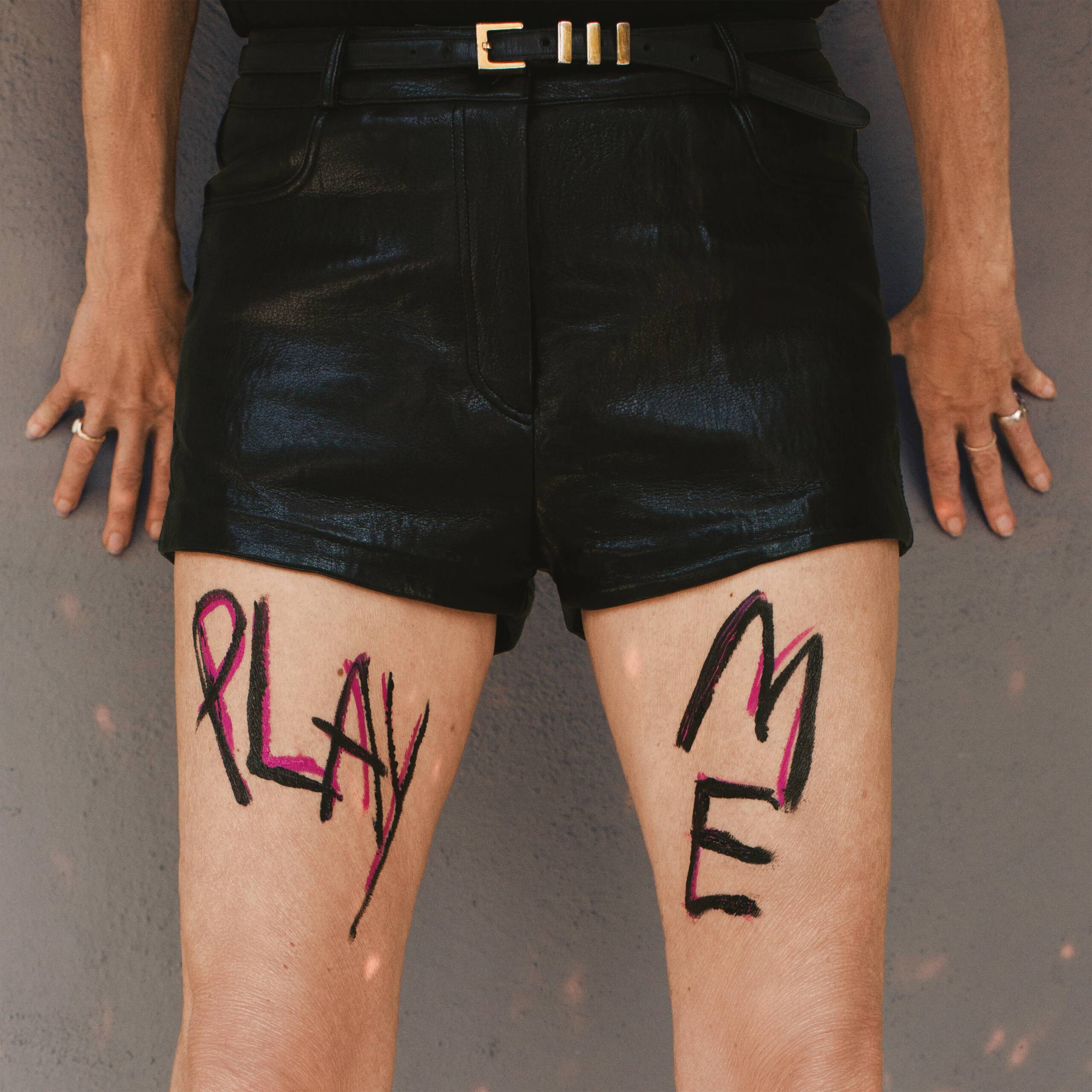
Gordon has referred to her music as a depiction of the modern landscape that carries an implicit critique of the culture. Her writing has the feel of found poetry or a cut-up, collaging the detritus of modern life—embodying the disoriented texture of contemporary existence. “I’ve always thought about things more sociologically,” Gordon says. PLAY ME, her third solo album, processes, in Gordon’s impressionistic way, the collateral damage of the billionaire class: the demolition of democracy, technocratic end-times fascism, the A.I.-fueled chill-vibes flattening of culture. Gordon is never literal; as author Rachel Kushner writes in her introduction to the 10th anniversary edition of Gordon’s bestselling memoir Girl in a Band, “She surfs the inscrutable.” Amid PLAY ME’s rabbit-hole reality bricolage—pitch-shifted vocals; shadowy layers of dissonance; “Fuck!”; is that Darby Crash?—her songs are still clear, in their own oblique ways, about the attention they pay to a world that would rather distract us into oblivion. “I have to say, the thing that influenced me most was the news,” Gordon says. “We are in some kind of ‘Post Empire’ now, where people just disappear,” she adds, echoing the title of one of PLAY ME’s songs.
A possible nod to political urgency and digital overload alike, PLAY ME is distilled and immediate. “We wanted the songs to be short,” Gordon says. “We wanted to do it really fast. It’s more focused, and maybe more confident. I always kind of work off of rhythms, and I knew I wanted it to be even more beat-oriented than the last one. Justin really gets my voice and my lyrics and he understands how I work—that came forth even more on this record.” Building on The Collective, which evoked Gordon’s caustic noise pedigree as much as punk- and grunge-inspired internet rap, PLAY ME expands her palette to include more melodic beats and the motorik drive of krautrock.
The taut skitter and screech of “No Hands” contains the recklessness of the national mood. The quaking bass and free-associative verses of “Subcon” suggest the bleak atomization of life in the platform era, before taunting would-be space colonizers: “You want to go Mars / And then what?” “Square Jaw” indicts Elon Musk’s divisive toxic masculinity by describing the visual blight of Tesla trucks. Narrating a person’s ominous total embrace of tech, “Dirty Tech” pities A.I.’s human victims who fail to recognize its environmental havoc. “I was kind of musing about, is my next boss going to be an AI chatbot?” Gordon says. “We’re the first ones whose lights are going to go out—not the tech billionaires. It’s so abstract that people can’t comprehend.” In using her own abstract language to describe reality, she begins to clarify it.
Dark humor voices the absurdity of modern life. “Busy Bee” warps a sample of Gordon talking with her Free Kitten bandmate Julia Cafritz during a ’90s media appearance, tweaking their conversation into high-pitched squeaks (Dave Grohl plays drums) to air seemingly contemporary sentiments (“the pressure to relax, it was just too much for her”). A work of timely opposition art, “BYEBYE25!” remakes Gordon’s The Collective opener with new lyrics repurposed from Trump’s banned-words list—terms the administration has flagged to cancel grant and research proposals. The terms range from “they/them,” “climate change,” and “uterus” to “bird flu,” “peanut allergy,” and “tile drainage” becoming, like many PLAY ME tracks, dryly hilarious. The title track sets the names of Spotify playlists over a trip-hop groove. “Rich popular girl / Villain mode / Jazz in the background / Chilling after work,” Gordon intones in her sprechgesang—another ridiculous list, the edges of each phrase melted like Gordon’s dripping Noise Paintings, representing the tyranny of frictionless culture. “It’s sort of part and parcel of the convenience culture that we live in, where our choices are kind of curated all the time,” Gordon says. “Things are branded in a way that tries to predict what your mood is before you have a mood. I find that interesting, and also really offensive.”
Despite its frequent gaze upon our age of collapse, PLAY ME is an interior record, one in which the anxieties of capitalism, welded like infernal scrap metal, are deeply felt. “It’s more inward, in a way,” Gordon says. “It’s a bit more emotional, and less outside of things.” That heightened emotionality pulses through PLAY ME’s krautrock jams, like the windswept “Not Today,” which brings out a poetic tension in her voice. “I started singing in a way I hadn’t sung in a long time,” Gordon says. “This other voice came out.” “A Girl With a Look” betrays how people project onto each other based on surface appearances. “It was sort of describing the feeling of being attracted to somebody and part of the attraction is actually that they’re not available,” Gordon says. “Desire is a kind of ping pong back and forth,” she adds, alluding to a filmmaking technique of her perennial influence, Catherine Breillart. Restless interiority animates Gordon’s work—rejecting definitive statements in favor of an inquisitiveness that keeps her searching, in conversation with reality and ever in process.
– Jenn Pelly
Publicity Contacts
Website
Press Kit
Photos