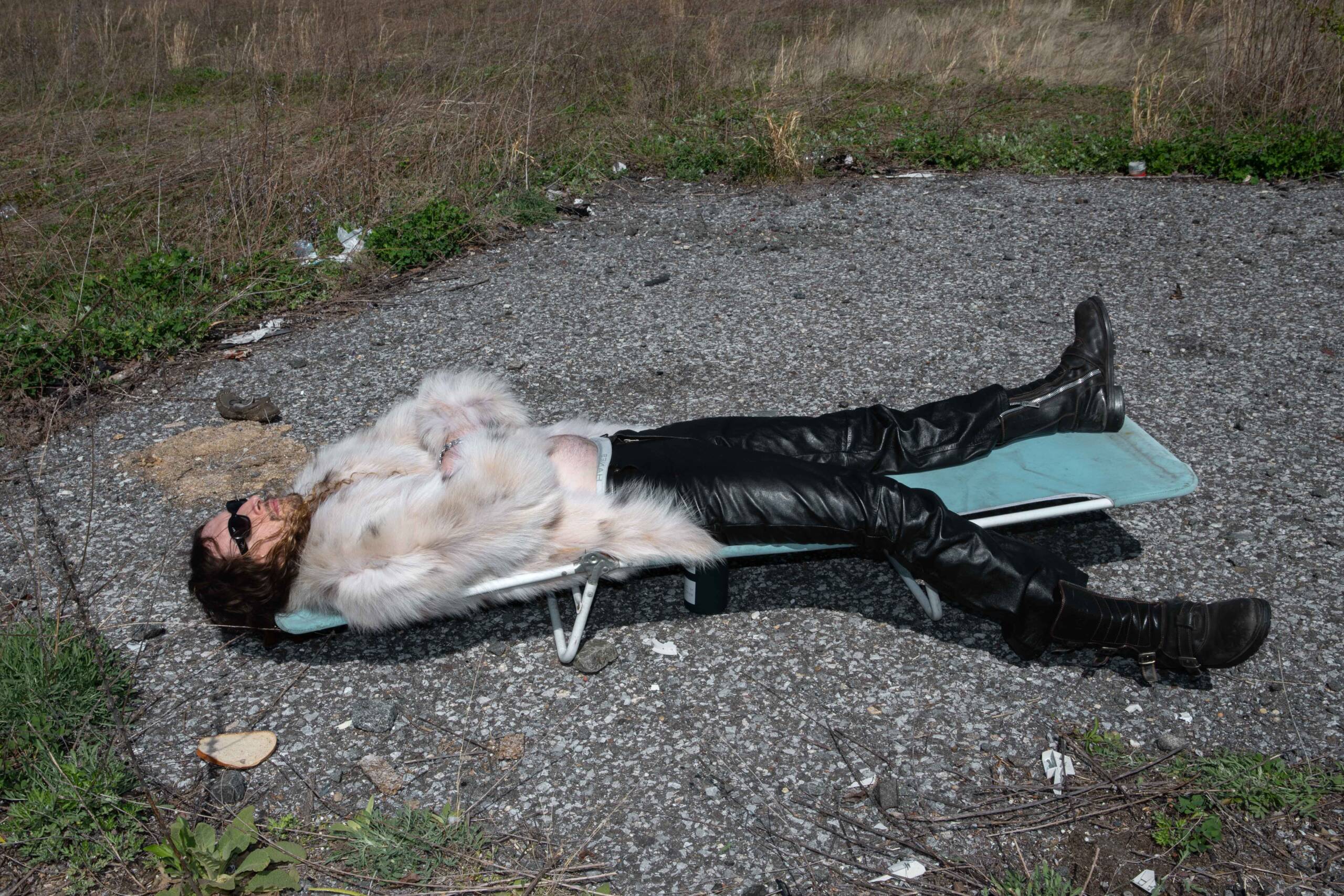
Morgan Garrett is one of the most fearless and fascinating artists in experimental music, and his new album Hick finds him charting new territory in a catalog that is full of surprises. The tension across these 12 songs is constantly wound and unspooled, as jagged guitar squalls and bursts of orchestral MIDI triggers cross paths with Morgan’s elastic and largely unvarnished baritone voice, presented with a nakedness and intimacy like never before. Equally reminiscent of grunge’s awesomely sludgy structures and the high-wire drama of The Glad Fact-era Dirty Projectors, Hick further establishes Morgan as operating in a class all his own.
In a sense, Morgan’s work across the 2020s has been building to the pivotal point that is Hick, which is seeing release on TAGABOW’s Philadelphia-based label Julia’s War, from his celebrated releases for venerable experimental label Orange Milk—2023’s Extreme Fantasy and the following year’s Purity—to tour support for like-minded forward-thinkers like Pissed Jeans, Water From Your Eyes, and YHWH Nailgun. The considerable road time was a point of inspiration when it came to Hick’s full-throated, baroque intentions: “In the midst of performing, the idea was to incorporate more of a live-band element into my music,” he explains. “I was focusing more on developing songs with a bigger feel to them.”
As Morgan began excavating the creative bones of Hick in his home studio, he shared the works-in-progress with the musical team that would end up lending a hand across the album: mastering engineer and frequent collaborator Alex Nagle, former Show Me the Body drummer Jackie McDermott (who now handles the sticks for Morgan’s own live sets), and YHWH Nailgun guitarist Saguiv Rosenstock, the latter of whom would helm much of Hick’s production throughout. “Saguiv specifically wanted to capture the feel of my live show, which is very intense and baffling—and I trusted him to do that.” Morgan says while talking about the trio’s contributions to the record, noting that McDermott brought a rhythmic sense of focus that, in his words, “Wrangled my bizarre timing sensibilities.”
The result is a record that shocks and soothes in equal turns, channeling the mind-blowing avant rock of This Heat as well as left-field trickster Dean Blunt’s heady, bewitching approach to soundscaping. Most notably, Morgan’s metallic howls that marked releases like Purity are very much still present throughout Hick—occasionally bursting into frame like fireworks in an abandoned apartment—but these songs also present his vocals more straightforwardly than in his previous records. As he tells it, the vocal transformation is partially a byproduct of his day job as a speech language pathologist in a nursing home: “How do you make sounds and utilize your voice? The training and experience has surely informed the artistry.”
This new approach also means that the lyrics are more front-and-center than ever on Hick, as Morgan embraces his freestyle-esque approach to probe his own inner workings in the midst of personal transition. “I’m exploring the sense of self related to change,” he explains, after mentioning that Hick began to come together after the end of a relationship. “Have I become someone different, or have I maintained my sense of self over time? I was moving into a different phase of life; my musical endeavors were becoming more serious, and the excitement of other people getting involved was balanced by someone leaving my life. This is definitely a record of me pondering how my sense of self remains amidst all that.”
As a result, Hick is streaked with loneliness, melancholy, and fear—with its unpredictable sonic structures reflecting the malleability that comes with one’s own shifting emotional state. Album opener “Stories” is dramatic and arresting, with orchestral MIDI melodies floating atop crisp, precise drum work, while “Hand of Sorrow (Doubt)” builds towards a sinister pulse and “One More Symphony” feels forged with fire, as Morgan’s vocals awesomely burble in the middle of iridescent strings and controlled cacophony. Then there’s the album’s first single “Honest Mistake,” which lurches forth with heavily distorted guitar and Morgan’s Layne Staley-esque vocals, before evolving into a rock triptych that encompasses ominous piano runs, doomy bass tones, and the type of hushed and unsettling balladry that was so prevalent in Scott Walker’s later works.
“I’m making myself clear with music that’s more tangible, and getting my ideas across effectively as a result,” Morgan reflects while talking about the song’s construction, before elaborating on how Hick is a crucial marker in terms of his own artistic growth: “I feel like I’m just getting started in terms of the ways in which I can express myself with camaraderie. The vision feels clear for this moment.” Indeed, Morgan’s unique musical perspective has been fully realized with bracing clarity on Hick, a record that’s delightfully complex and unique even amidst its creator’s increasingly singular oeuvre.
Publicity Contacts
Photos