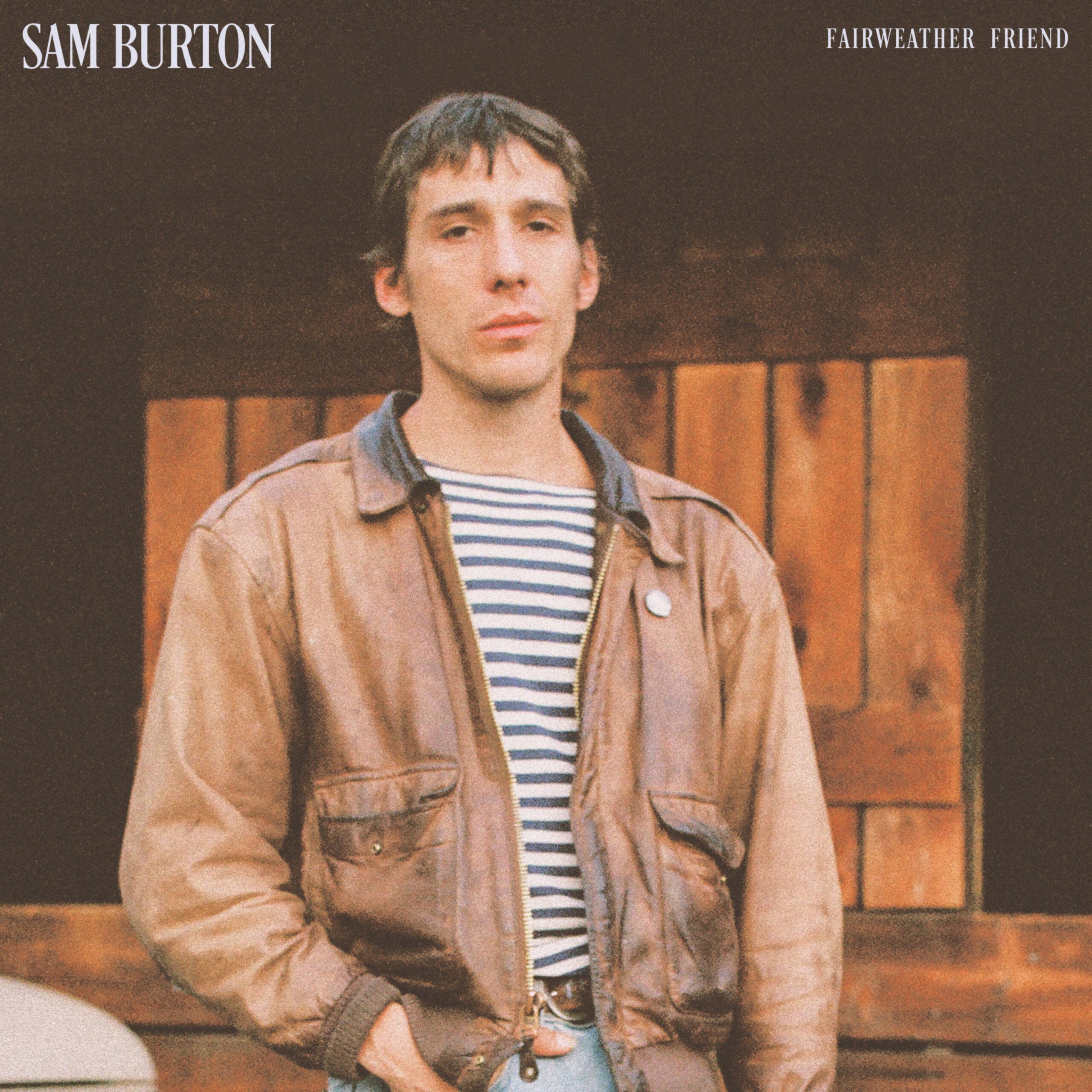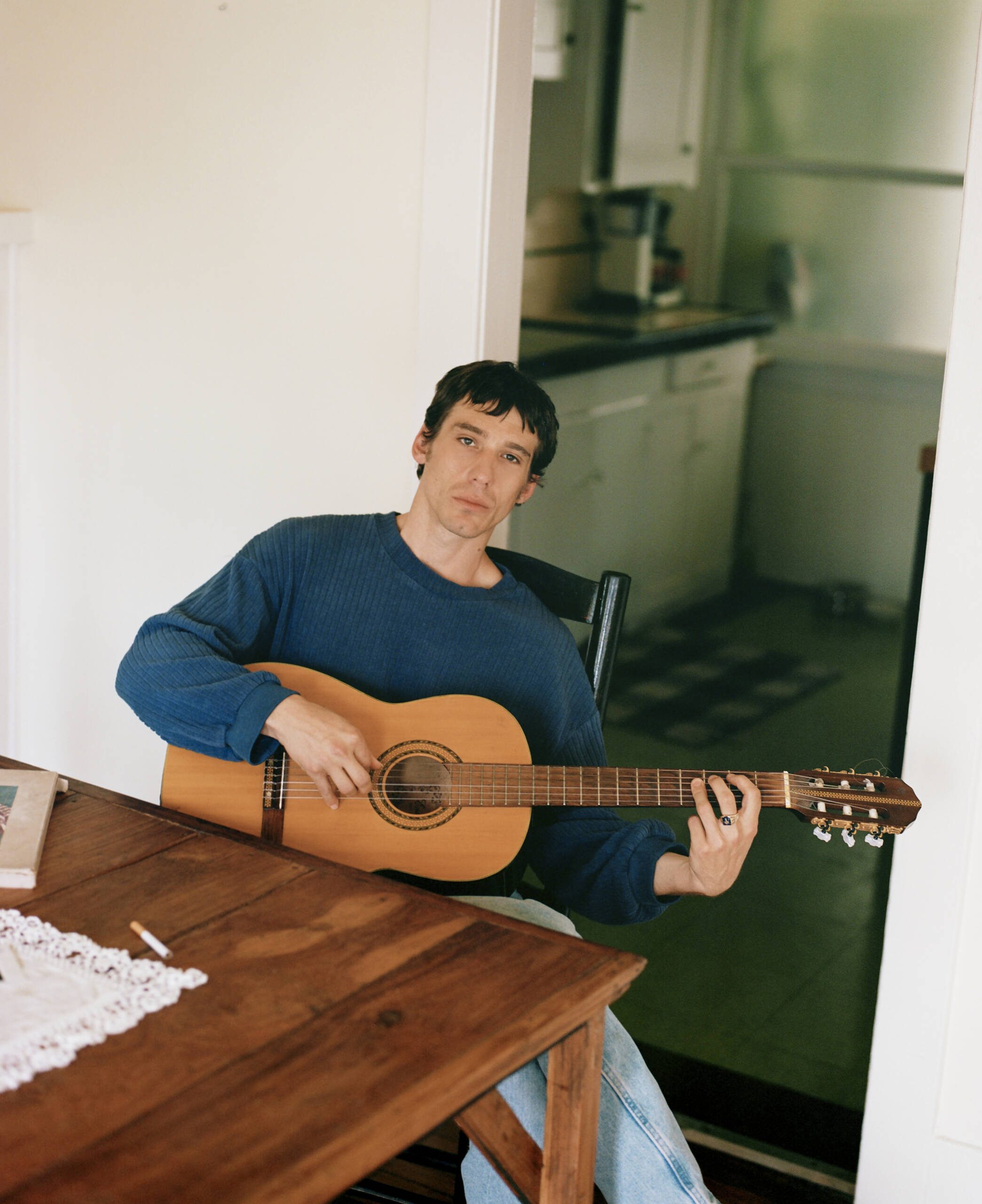
Sam Burton has always made music full of the hope of possibility and unbound potential that also channels the tension of accepting loss while still grieving it. Now, Burton is at his most confident and self assured—he’s at ease in his depth. Fairweather Friend is the Palestinian-American musician’s third solo record since moving to Los Angeles from his home state of Utah in 2016. In the decade since his move, almost everything changed for the artist, and his songwriting acted as a guide through the changes, mirroring transformation, sometimes even before it had happened, in a kind of unconscious foreshadowing.
Fairweather Friend expands with the artist: minimal, stark production and live, raw performances that feel familiar to Bob Dylan’s New Morning, with acoustic guitar interplay and occasional flickers that recall John Renbourn and Bert Jansch.
Burton was living a nomadic lifestyle during the period in which the record was made. Through this transitory period he sees cycles begin and end. The record began in the wake of a bad car accident while on tour with the band Burton was in during and post-pandemic. He and his bandmates were lucky to be alive. Struggling with guilt—Burton had been driving at the time, though the accident wasn’t his fault—they bonded through a process of healing together; he was moved by and deeply grateful for their love and support. Then the project split. Some relationships ended, others started, and Burton left for a series of tours playing solo, stripped-down sets for bigger audiences. Back in Los Angeles, he began writing again.
“I think a lot of things were changing, including the way LA used to feel for me when I was young and I felt like I could do anything,” he says. Now, “It felt like certain doors were closing. But the growth was inspiring to me. And I liked that.” Coming off such extensive touring, he began writing with solo performance in mind, rather than exclusively for a band— elevating his own guitar playing by studying solo performances by artists like Neil Young and Jansch. He spent several months in Northern California, near the town of Humboldt, working on a farm and spending long days writing. He began a period of deep reflection, looking, he says, for the piece of himself he’d often found in others. There, he wrote nearly half of the new record.
“I was in this really beautiful, natural environment and I felt like I could reflect easily,” he recalls. “I’d get aligned with the sun—go to bed early, get up early, pay attention to nature, work on the farm. Part of it was consciously thinking about these things I felt were changing. And then part of it was unconscious—I was having powerful dreams. I’d wake up with an emotion and I
would go with it, try to let that guide what the song would be.” (Burton, who began studying Jungian psychology in 2018 and reads tarot for himself and others, says Jung’s work taught him to trust his dreams and his emotions; he’s since found immense value in those things.)
Burton, who records all his songs live, first returned to the studio with Jonathan Wilson (Father John Misty, Coner Oberst), who also produced Burton’s last record Dear Departed. When they’d finished, he wanted to try cutting a few of the songs again. Since Wilson was already busy with other projects, Burton and his bandmates went into his drummer Pierce Gibson’s studio, Recorders, in Echo Park. The portion of the record they cut there was directed and arranged by Burton and the band, done without a producer in the communal spirit of connection and love that had bonded the band together in the first place. You can hear it on those tracks. When the record was finished, Burton says for him, a cycle felt like it had completed; a new one could begin.
There’s a new energy here: the song’s title track explores the uplift you feel with people you love, and the heartbreak that comes with realizing that some things aren’t meant to last. It’s flecked with an anger that feels cathartic —in ‘Picture People’ Burton paints an image of LA, and an industry of apparent glamor once illusions have faded, but without exempting himself. On ‘Free Again,’ there is a poetic forgiveness: Now the sun’s on your face in the height of the day / I have seen your face too / And you’re not so blind I’m sure you can find / Mine to see through, he sings. Across the album is an underlying, tangible fear, and simultaneous embrace of the unknown, which is hard to write about; Burton does it in a way that makes the songs addicting and repeatable. Finally there’s surrender, the thing that leads to true freedom. From Fairweather Friend: High above the buildings / I’m high in the clouds / Not high enough to make it out / But I’ve done my time / I can live without.
Sam Burton writes, essentially, folk music, but to limit him to the genre doesn’t feel like it does justice to his work —his depth places him in the legacy of singer-songwriter acts like Fred Neil, Bob Dylan, Nick Drake, Leonard Cohen. Musically, lyrically, and spiritually, he finds an edge in his songwriting that shows he’s willing to fall: accepting some losses as irretrievable, and relentlessly, almost compulsively, pursuing his destiny, no matter how lonely the pursuit can be. “I’m really just doing this because I have a compulsion to do it. And I have found wholeness—or something that felt like wholeness—doing it my whole life.”
From ‘I’m a Stranger’:
See the sky turn and fly over many lands
It drew the line so deep and fine but now I understand
What a stranger I am
Publicity Contacts
Photos